Guide
Flight numbers explained
A disc's four numbers describe how fast it wants to go, how long it stays up, and which way it curves. They are a starting point, not a guarantee.
Destroyer, 12 / 5 / −1 / 3
| Disc | Numbers | Distance | Lands |
|---|---|---|---|
| Destroyer | 12 / 5 / −1 / 3 | 128 m | lands 14 m left |
Destroyer · ~128 m · lands 14 m leftEstimated flight · Arm speed: Intermediate · Right-hand backhand
Estimated flight · Arm speed: Intermediate · Right-hand backhand. The full chart lets you change both.
Speed
Speed is the rim speed the disc is designed for, on the maker's own 1–14 scale. It is not a measurement in metres per second. A high-speed driver has a wide, sharp rim; a putter has a deep, blunt one. The number tells you how hard the disc wants to be thrown, and therefore who it is for.
A disc thrown below its speed flies slower than its rating suggests: it fades early and does not carry. A disc thrown above its speed can turn further than intended. That is why a beginner often gets more distance from a midrange than from a distance driver, even though the driver has the higher number.
Glide
Glide is how well the disc stays in the air, from 1 to 7. High glide keeps the disc aloft longer and makes it more sensitive to wind and to a high or low release. Low glide is easier to control into wind and on a low line. Glide is the number people notice last and the one that changes a disc's character most.
Turn
Turn describes how much the disc curves right at the start of its flight for a right-hand backhand, before it fades back. It is written from +1 (very resistant to turning) to −5 or lower (very willing). A negative turn is not a bad thing: it is what lets a slower arm get a full flight out of a disc, and what lets a faster arm shape a turnover.
Turn is the number most dependent on arm speed. A disc with −3 turn thrown by a strong arm may flip over; thrown by a slower arm it may fly straight. The number is the disc's potential, not its behaviour in your hand.
Fade
Fade is how strongly the disc hooks left at the end of a right-hand backhand, from 0 to 5. It is the low-speed part of the flight, so it shows up late and is less affected by arm speed than turn. A fade of 4 or 5 finishes hard; a fade of 0 lands almost where it was pointing.
How the four work together
A disc with high speed, low turn and high fade is a wind-fighting driver: it will not flip, and it finishes left. A disc with high glide, negative turn and low fade is a turnover midrange: it drifts right and stays there. A putter with low speed, low glide and moderate fade is a straight, predictable approach disc.
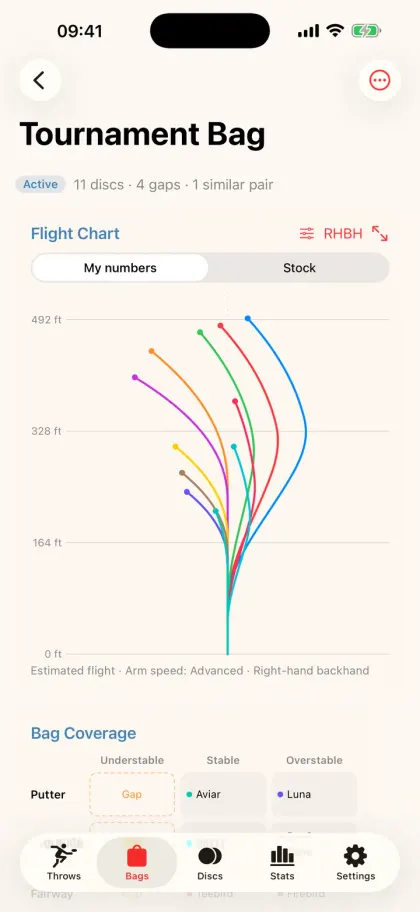
The useful comparison is not the sum of the numbers but the shape of the flight. The chart above draws that shape for one disc. Change the disc in the flight chart or add several to compare them at the same arm speed.
A worked example
Take a Destroyer: 12 speed, 5 glide, −1 turn, 3 fade. At intermediate arm speed it drifts right through the middle of the flight, then fades back across the centre line and lands about 14 m left at 128 m. At pro arm speed the extra speed makes the turn stronger and the fade weaker, so it lands closer to straight at 168 m. The numbers did not change; the arm did.
That is the point of a flight chart. It does not tell you a disc is good or bad. It shows what the disc does at the speed you actually throw, which is the only question that matters when you are choosing one.
Where the numbers come from
Every manufacturer publishes its own ratings. Innova's scale is the one most people learn first; Discraft, Discmania, Latitude 64 and the rest use their own. The catalogue on this site records each maker's published numbers with a source, and says plainly that they are ratings rather than measurements.
What is a good speed for a beginner?
A putter or a midrange, usually speed 2 to 5. A distance driver needs arm speed to fly as its numbers suggest; thrown slowly it fades early and goes no further than a midrange.
Do the numbers add up to a stability rating?
Turn plus fade is a rough summary, but it is not how DiscScout's grid classifies a disc. The grid uses where the disc lands relative to straight at your arm speed, because a fast disc can be overstable for a slow arm and stable for a fast one.
Why do two discs with the same numbers fly differently?
Plastic, weight, dome, wear and the run all change the flight. The numbers are a starting point from the maker, not a measurement of the disc in your hand.
Are the numbers the same across brands?
No. Each manufacturer rates its own discs. A 7 from one maker is not calibrated against a 7 from another; compare shapes and stability rather than treating the scale as universal.
Sources
- Flight ratings system, Innova Discs. Checked 2026-11-05. Each manufacturer rates its own discs; the numbers are not a shared scale.
- Discraft flight ratings, Discraft. Checked 2026-11-05.
- DiscScout's flight model (FlightModel.swift), SGWNI. Checked 2026-11-05. A visual approximation tuned to published charts, not a physics simulation. Ported to this site unchanged.
- DiscScout's bag analysis (BagAnalysis.swift), SGWNI. Checked 2026-11-05. Stability from the landing ratio: < −0.09 overstable, > 0.03 understable, else stable.
DiscScout
DiscScout uses your numbers, not just the sticker
Enter how a beat-in disc actually flies and the charts and coverage follow. Switch back to stock when you want the maker's rating.