Guide
Understable vs overstable
The difference is not a property of the disc alone. It is how the disc behaves for the arm throwing it.
Three discs, one arm speed
- Firebird 9 / 3 / 0 / 4
- Buzzz 5 / 4 / −1 / 1
- Leopard 6 / 5 / −2 / 1
| Disc | Numbers | Distance | Lands |
|---|---|---|---|
| Firebird | 9 / 3 / 0 / 4 | 114 m | lands 19 m left |
| Buzzz | 5 / 4 / −1 / 1 | 86 m | lands straight |
| Leopard | 6 / 5 / −2 / 1 | 97 m | lands 7 m right |
3 discsEstimated flight · Arm speed: Intermediate · Right-hand backhand
Estimated flight · Arm speed: Intermediate · Right-hand backhand. Firebird overstable, Buzzz stable, Leopard understable at this speed.
The short answer
For a right-hand backhand, an understable disc turns to the right during its flight. An overstable disc resists that turn and fades to the left at the end. A stable disc does neither strongly and holds the line you release it on. Left-hand backhand and right-hand forehand mirror all of it.
Those are tendencies, not fixed labels. The same disc can be overstable for one player and stable for another, because the disc responds to how fast it is thrown. The numbers on the disc are the manufacturer's estimate for a typical arm; the flight in front of you is the answer for yours.
Why arm speed changes the answer
A disc turns when the air moving over it is fast enough to overcome its stability. Throw a distance driver slowly and the air is not fast enough: it never turns, and it fades early. Throw it hard and it turns. That is why a beginner's overstable driver can become a pro's straight driver, and why a disc that suits one player can be unusable for another.
The three discs above make the point. The Firebird is designed not to turn; the Leopard is designed to turn. At intermediate speed the difference is obvious. At beginner speed the Leopard may still turn but the Firebird will fade early; at pro speed the Leopard may turn too far and the Firebird may fly straight for the first time.
The landing-ratio test
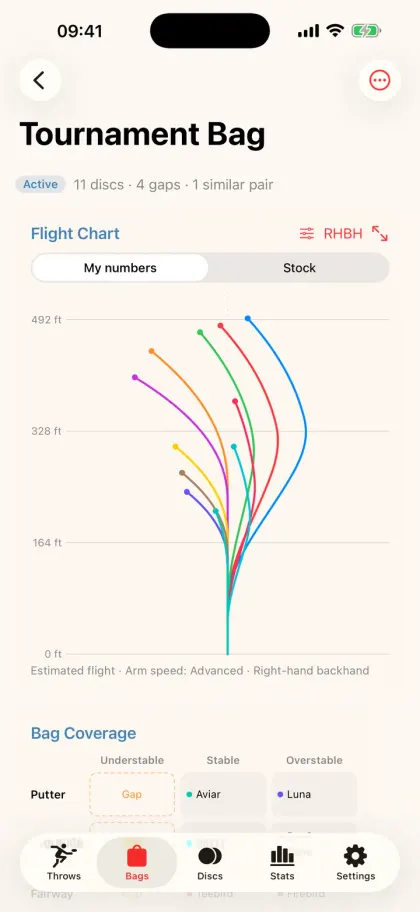
DiscScout does not classify stability by adding turn and fade. It flies the disc and looks at where it lands relative to the straight line from the tee. If it finishes more than about 9% of its distance to the left, it is overstable; more than 3% to the right, understable; in between, stable. The thresholds are in the app's own code.
This matters because it makes the grid agree with the chart. A disc that looks understable on paper but flies straight for your arm is placed as stable, which is the useful answer. The bag builder uses the same rule, so a gap in the grid is an empty cell: no disc in the bag lands in that speed-and-stability combination.
When to choose each
Overstable discs are for wind, for forehands, for skip shots and for finishing left. They are forgiving of a bad release because they want to fade back. The cost is distance for a slower arm and a flight that can be one-dimensional.
Understable discs are for turnovers, for rollers, for narrow woods lines and for players whose arm speed is below the disc's rating. They are less forgiving in wind and more sensitive to release angle.
Stable discs are the ones you can throw at a target without thinking about shape. A bag usually needs more stable discs than understable ones.
What a balanced bag looks like
The usual mistake is a bag full of overstable distance drivers and nothing that turns. The second mistake is the opposite: a bag of understable midranges with no wind disc. A balanced bag has at least one disc in each stability band for the speeds you actually throw, and no two discs that do the same job.
The coverage grid on the bag builder shows this at a glance: twelve cells, the discs in each, and the empty ones. How to build a disc golf bag goes through what to do with them.
Is understable the same as flippy?
In practice, yes: a disc that turns right for a right-hand backhand is called understable or flippy. Overstable means it resists turning and fades left. Stable means it does neither strongly.
Can a disc change stability?
Yes. Wear makes a disc more understable over time, and a lighter disc or a different plastic can fly differently from the same mould. Arm speed matters too: the same disc can be overstable for a beginner and stable for a pro.
Which should a beginner throw?
Something stable to slightly understable in a putter or midrange, so it flies straight at modest speed. A very overstable disc will fade early and hide mistakes; a very understable one will turn into the ground.
How do I know which one I have?
Throw it flat with no wind and watch where it finishes. Finishing left of the line for a right-hand backhand is overstable; right is understable. The chart here does the same from the numbers.
Sources
- DiscScout's bag analysis (BagAnalysis.swift), SGWNI. Checked 2026-11-05. Stability from the landing ratio: < −0.09 overstable, > 0.03 understable, else stable.
- DiscScout's flight model (FlightModel.swift), SGWNI. Checked 2026-11-05. A visual approximation tuned to published charts, not a physics simulation. Ported to this site unchanged.
- Flight ratings system, Innova Discs. Checked 2026-11-05. Each manufacturer rates its own discs; the numbers are not a shared scale.
DiscScout
See your own discs in the same grid
DiscScout charts your bag at your arm speed, then puts every disc in a speed-by-stability cell so the gaps are obvious.