Build a bag that covers every shot
Search 241 discs or add your own, chart every flight at your arm speed, and see the gaps and near-duplicates before you buy another disc.
Your bag
Estimated flight · Arm speed: Intermediate · Right-hand backhand
A shared bag, opened from a link.
Bag coverage
In the bag
What the grid shows
Every disc lands in one of 12 cells: four speed classes by three stabilities. The class comes from the disc's speed. The stability comes from where its estimated flight finishes: a disc that lands more than about 9% of its distance left of the centre line is overstable, more than 3% right is understable, and anything between is stable.
That is why the same Destroyer can read overstable for an intermediate arm and stable for a pro arm. Stability is a relationship between the disc and the thrower, not a fixed label.
Gaps and similar flights
A gap is a cell with no disc in it. Tap one and the builder looks for a disc that would land there: first any retired disc of yours that fits, then discs from the catalogue at the current arm speed and throw. The suggestions use the manufacturers' numbers, so treat them as a shortlist rather than a shopping list.
A similar pair is two discs in the same cell that land within a few metres of each other: within max(6 m, 5% of the longer distance) and max(3 m, 3% of the longer distance) laterally. Carrying both rarely gives you a shot the other cannot.
Stock and your own numbers
If you have a beat-in disc that no longer flies like the sticker says, add it as a custom disc with your own numbers, or use the app's My numbers view. The charts and the grid follow whichever set is selected. The app keeps both sets per disc; this page keeps one custom set per disc.
The page opens with a sample bag so the chart is never empty. Add or edit a disc and it becomes your bag; "New bag" starts an empty one.
Sharing, printing and keeping it
Copy link puts the whole bag in the link, so it opens without an account. Print bag card gives a monochrome chart, the legend, the grid and the gaps on one page. Export image draws a 1600 × 1200 PNG, and the JSON export is there so you can move bags between browsers.
Bags stay in this browser's storage; a shared link puts the bag in the address, not on a server. The site counts anonymous actions, such as adding a disc or opening a gap, without an identifier; the privacy page has the detail.
Done with the bag? See how one disc flies at each arm speed, or compare up to six before you buy.
How does the coverage grid work?
Each disc goes in a speed class (putter, midrange, fairway, distance) and a stability band. Stability comes from where its estimated flight lands relative to straight: more than about 9% left is overstable, more than 3% right is understable, and anything between is stable. An empty cell is a gap.
What counts as a similar flight?
Two discs in the same cell whose landings are within max(6 m, 5% of the longer distance) and max(3 m, 3% of the longer distance) of each other. They are close enough that carrying both rarely adds a shot.
Where do the disc numbers come from?
Manufacturers' published flight ratings, compiled by hand with the source recorded for every disc. They are each maker's own scale and do not compare exactly across brands. You can always type a disc and its numbers yourself.
Are the flight lines exact?
No. They are estimates from the flight numbers and arm speed, using the same model as DiscScout, tuned to look like published charts. Plastic, wear, wind and release change the real flight.
Is my bag uploaded?
No. Bags are saved in this browser only. A shared link carries the bag in its URL, so anyone with the link can open it; nothing is stored on a server.
Sources
- DiscScout's flight model (FlightModel.swift), SGWNI. Checked 2026-11-05. A visual approximation tuned to published charts, not a physics simulation. Ported to this site unchanged.
- DiscScout's bag analysis (BagAnalysis.swift), SGWNI. Checked 2026-11-05. Stability from the landing ratio: < −0.09 overstable, > 0.03 understable, else stable.
- Flight ratings system, Innova Discs. Checked 2026-11-05. Each manufacturer rates its own discs; the numbers are not a shared scale.
- Discraft flight ratings, Discraft. Checked 2026-11-05.
DiscScout
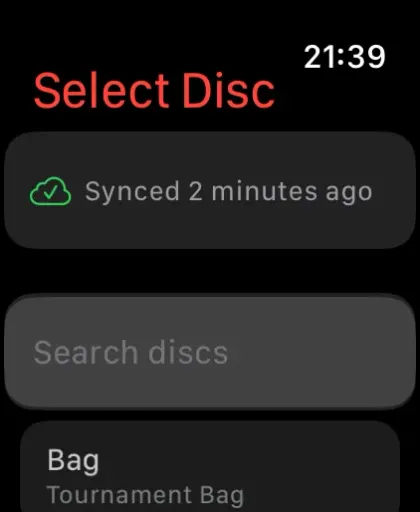
Your bag, on your wrist, with DiscScout
DiscScout keeps your bags in iCloud, records throws from Apple Watch and shows which of your discs you have actually thrown a distance.