Guide
How to build a disc golf bag
A good bag is not the longest list of discs. It is a set that covers the shots you need without four discs that do the same thing.
The sample bag, at intermediate arm speed
13 active discs. Each cell is a speed class and a stability band; dashed cells are gaps. Open the bag builder to change the discs, the arm speed or the throw.
13 discs · 4 gaps · 0 similar pairsEstimated flights · Intermediate · RHBH
Start with the shots, not the discs
List the shots you actually play on your home course: the straight putt, the approach that has to stop, the fairway driver that has to turn, the forehand that has to finish left. Then choose discs that produce those shots. A bag built this way is shorter and easier to trust than one built from a list of popular moulds.
If you are new, the list is short: a putter you can throw straight, a midrange that holds a line, something understable for turnovers, and one fairway driver. Four discs cover a surprising amount of a normal course, and each one has a job you can describe.
Coverage, not count
Coverage is the range of flights a bag can produce. The grid has twelve cells: putter, midrange, fairway and distance, each split into understable, stable and overstable. A bag with one disc in each of the cells you use has coverage. A bag with five overstable distance drivers has five discs and one flight.
Count the cells, not the discs. A disc you never throw is not coverage. A disc you throw for one specific shot is.
What the sample bag shows
The 13-disc sample above is a realistic intermediate bag. It has four gaps, all understable: no understable putter, midrange, fairway or distance driver at intermediate arm speed. That is common in a first bag: stable and overstable discs are easier to trust, so angle does the work of an understable disc.
It also has no similar pairs: no two discs in the same cell land close enough to be called near-identical. That is the other half of a good bag. A pair of discs that do the same thing is two slots spent on one shot.
Filling a gap
A gap does not always need a new disc. Sometimes the shot is covered by a disc in another cell thrown on a different angle, and sometimes you genuinely do not need the shot. The useful test is whether you have lost strokes to it. If you have, fill it; if not, leave it empty and carry something you use.
The bag builder lists candidates for a gap from the catalogue, using the manufacturers' numbers. Treat the list as a shortlist: a disc that lands in the cell at your arm speed is a candidate, not a guarantee that it will feel right in your hand.
Near-identical flights
Two discs in the same cell whose landings are within a few metres of each other are a similar pair. The tolerance is generous: within max(6 m, 5% of the longer distance) in distance and max(3 m, 3%) sideways. If they are that close, one of them is a spare.
Keep the one you trust and retire the other, or keep it as a practice copy. The app has a retired state for exactly this: out of the chart, still in the list.
How many discs is enough
Enough to cover the shots you use, plus one spare of the disc you throw most. A useful target is 8 to 12. A larger bag is not better; it is heavier and it makes choosing slower. A smaller bag with deliberate coverage plays faster and teaches you the discs you have.
When to change it
Change a bag when a shot costs you strokes, not when a new mould is released. Add a disc to fill a specific gap; retire one when it duplicates another. Recheck the grid after a few rounds: the arm speed you enter is an estimate, and the disc that was stable in March may be understable by August.
How many discs do I need?
A useful default is 8 to 12 discs: enough for the shots you actually use. A beginner can cover a course with 4 to 6: a putter, a straight midrange, an understable midrange or fairway, and one fairway driver.
What is a bag gap?
An empty cell in the speed-by-stability grid: no disc in your bag lands in that combination of distance and finish. The shot may still be shapeable with another disc, but the cell is empty.
Does the grid use my arm speed?
Yes. Every disc is flown at your arm speed, so stability is what you would see on the course rather than what the sticker implies.
Should I carry duplicates?
A second copy of the disc you throw most is useful, especially if you practise with one and play with another. Two different discs that fly the same is not.
Sources
- DiscScout's bag analysis (BagAnalysis.swift), SGWNI. Checked 2026-11-05. Stability from the landing ratio: < −0.09 overstable, > 0.03 understable, else stable.
- DiscScout's flight model (FlightModel.swift), SGWNI. Checked 2026-11-05. A visual approximation tuned to published charts, not a physics simulation. Ported to this site unchanged.
- Flight ratings system, Innova Discs. Checked 2026-11-05. Each manufacturer rates its own discs; the numbers are not a shared scale.
DiscScout
Build it in the browser, then take it to the Watch
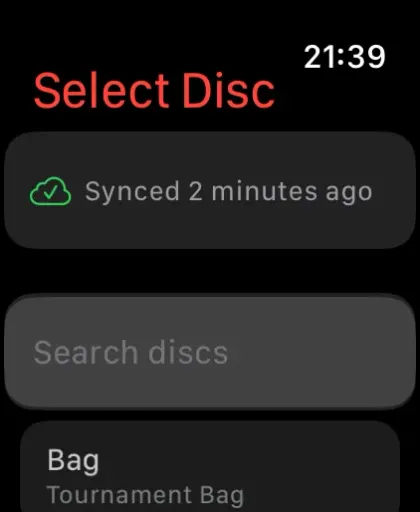
The bag builder shows the flights, the coverage and the gaps. DiscScout keeps the bag in iCloud and uses it as the Watch's disc list.